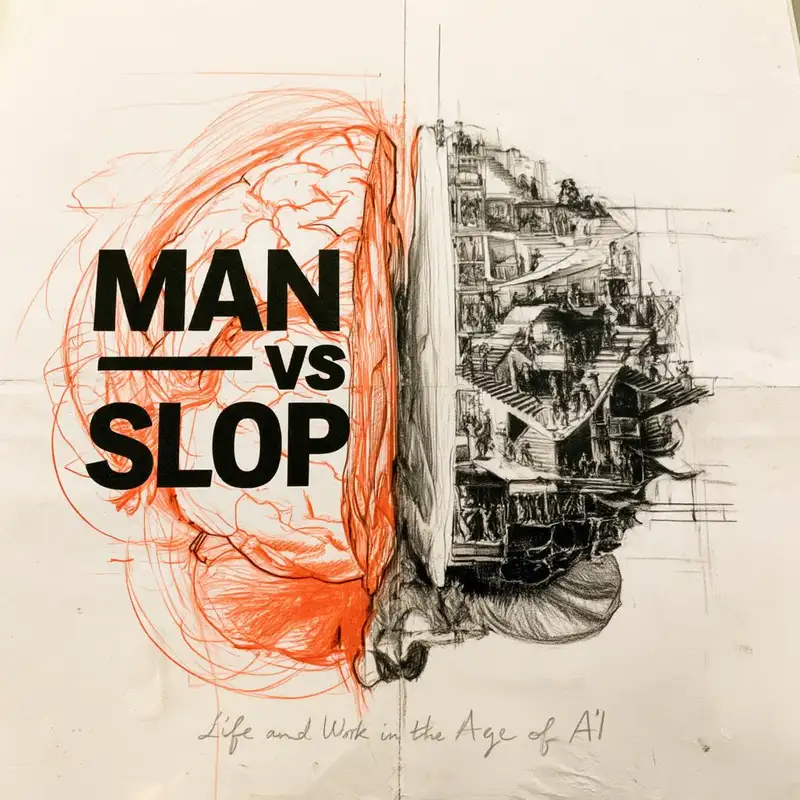
Sloppy Joes and the Start of Another AI Podcast (with Aleck McCathie & Kent Gustavson)
Welcome to the Man vs. Slop podcast. I'm Kent Gustavson.
Aleck McCathie:And I'm Aleck McCathie.
Kent Gustavson:And we like to talk about slop. Is that how we start this show?
Aleck McCathie:Maybe. I may be talking about what slop even is, I guess.
Kent Gustavson:When I was a kid, when I used to eat meat, should say, there were these sloppy joes. Actually, had now they have like sloppy lentil, which is not the same thing. But slop, it's funny. If you're a pig, you love slop because that means like all the the goodies that come off the table. But I guess as humans, we're thinking slop is what?
Aleck McCathie:I don't know. I mean, I always picture the, you know, generic prison food where it's you can't really tell what it is, but you know it's low quality.
Kent Gustavson:Yeah. What's your what's your experience with prison food?
Aleck McCathie:I mean, I I guess, you know, it it's a sitcom type trope where you're walking down the lineup with your little tray and you just get some plop of, like, unknown material on your little tray. Right?
Kent Gustavson:I like that because that's the the sitcom vibes is how we've titled this thing. So Man vs. Slop. We gotta address the gorilla in the room, which is, you know, we're two men, so we mean sort of humankind, but also men, because we're men. But but theoretically, the idea is, you know, man versus machine or or humans versus AI, because we're living in that that crazy world right now.
Kent Gustavson:I guess that's my take on that.
Aleck McCathie:Yeah. Similar for me. I mean, I think about Man vs. Slop is, you know, so it's an existential sort of versus at this point, thinking about how, you know, humankind should be dealing with this emergence of slop and what it means, and whether maybe we should even be fighting it, or how we should deal with it in general, I guess.
Kent Gustavson:So we gotta start with the Bible. In the in the the time before well, in in every single mythological tradition, the time before there was stuff, there was primordial goo, or like the big bang. Before there was the bang, there was something. There was some, like, you know, really tiny goo or something, like or, like, on a the tip of a pin. But there's always been slop.
Kent Gustavson:There's always been mud. There's always been junk. There's always been wasted material. There's been some guy over on the corner of a marketplace just spouting stuff that sounded like nonsense to everybody else. So we've always had slop.
Aleck McCathie:Yeah. I mean, one example that comes to mind that might be I don't know. It might date me, but the idea of tabloids. You know, those silly magazine newspaper things that you would see on the stand sometimes that are filled with the most bogus conspiracy celebrity headlines and stuff like that. I I think that generally, the type of people who would read the newspaper would look at that and say, that's like the sloppy version of the news.
Kent Gustavson:What's a newspaper?
Aleck McCathie:Oh, yeah. Again, dating me, guess. The physical version of the news.
Kent Gustavson:So that what's but let's think about it. So so Man vs. Slop, we're looking at the importance of AI in our lives. And is it actually important? I think that's part of the joke of Slop is, you know, people sling that around as if everything on LinkedIn, for example, that's been generated by AI is Slop.
Kent Gustavson:And that's not true, because just about everybody is using AI, and they have been for years because they use everything from spell check to grammar check to now they're using it to polish their stuff up. And I think there's a difference between, you know, fully generated stuff versus polished up stuff, which I still dislike personally, or, you know, I don't know, things that people got from sparring with AI, and actually, woah, they're actually saying compelling content for the first time because they're getting clarity. So it's it's it's like slop isn't the same as slop.
Aleck McCathie:Yeah. I'd have to agree. I think that for me, the LinkedIn example rings very true. I mean, I I'm guilty of feeling that way myself. And I I think that people are sort of gaining a sixth sense to see signal through the noise.
Aleck McCathie:And a lot of posts that you might see on LinkedIn do look the same, and they they might look kind of sloppy. And I think that it's that sparring that makes the difference. And sparring can mean just spending the time collaborating, making sure that your own human thought is going into, the tool that you're using to help you articulate yourself rather than allowing the tool to maybe do all the work.
Kent Gustavson:So LinkedIn literally rolled out a feature that said, seems like AI slop. I think we should start there because it's like it's like when you go to a cafeteria and some food comes out to you and you're like, seems like that's, I don't know, okra, or it seems like it's, you know, something that I'm familiar with, but it's not. So the seems like is a very interesting way of presenting this, and what what LinkedIn apparently has has done is then reports that to the people who created the post, then the people will maybe use AI a little less or make it a little less sloppy. I find that kind of interesting.
Aleck McCathie:Yeah. I haven't seen any of those flags myself, but I guess I haven't been looking very hard. I mean, like I said, for me, it's a bit of a success. I I from my own experimenting with AI and GPT and having it generate content, I I think that it's pretty obvious when somebody goes in and says, I'd like to make a post about x based on best practices. And the outputs you'll get by doing that look exactly like probably many posts you've seen across the whole Internet.
Aleck McCathie:I mean, it's not just LinkedIn. There's lots of blogs. There's other social medias and other places where people are doing that. But it it's definitely something that doesn't resonate as much as content that is built with some amount of soul, for lack of a better term?
Kent Gustavson:So speaking of soul, I think we shouldn't leave music out. You know, we're in the writing industry, but I got my start in the music industry. Deezer, which is kind of an interesting network that has kind of gone in and out of importance, it's kind of a cool site. But Deezer, they ran a whole international survey, and they have all kinds of interesting features. Thirteen point four million AI tracks were tagged last year.
Kent Gustavson:This year I'm sure is a lot more. Actually, can say is. So, in April, there were 75,000 AI tracks a day uploaded. So 44% of uploads were AI. In July, just a couple months later, more than 50% of uploads.
Kent Gustavson:So what people are doing is using AI to generate tracks, and then they're uploading it to all these channels hoping that their, you know, their track will be the runaway like lottery ticket. You know, there's a couple of these AI generated songs that have have been these lottery tickets, and and people start singing because they're the meme meme of the week. Right? But I find that interesting, so it's you generate all that slop. What what's good about that is nobody listens to it.
Kent Gustavson:Right? So you can upload it, nobody listens to It's a big pond of slop, I guess, that nobody wants to to wade into.
Aleck McCathie:Yeah. And I've heard of many similar situations. I think that it's such an accessible tool to so many people that, you know, that everyone's trying their own version of what a get rich quick scheme might look like. And it's it's something that I've had a lot of conversations about where I think it's removing the accountability from the content you're creating. Like, if you can just inundate a platform with thousands of songs that you did probably didn't really review or listen to and you're just hoping that one gets traction, it's kind of a shame.
Aleck McCathie:And that's I think part of what makes it Slop is that there's no real accountability or, like, human care behind the submission. Like, it's kind of if you're just throwing a thousand things against the wall, try to see what sticks. It's like a volume versus, you know, quality content situation.
Kent Gustavson:So I wanna transition us a minute. So, we probably should say a little about what what we do in the world where we sit. I'm a I'm kind of a crazy person who sees a little bit of crazy in everybody, and I like the word crazy, because it means cracked. It means and I I like to think of these cracks in people where light shines through. You got all those metaphors.
Kent Gustavson:And I like to see what's different in people. And so for me, AI is awful on one side because it it makes everybody vanilla. Like, everybody just says, oh, turn this into a post, and then it goes out on the Internet and it's vanilla, and nobody listens, nobody looks at it or listens to the track or whatever. But on the flip side, somebody who comes up with a genius idea and they they tell their AI to run with it in an interesting way, they can get these frameworks, they can change their business, they can create new software. It's pretty amazing.
Kent Gustavson:So I see AI where I sit in the world, and I'm a writer, I'm an entrepreneur, I've started a bunch of businesses over the years in publishing and across the board, But now I'm fascinated by everybody from age, I don't know, 90 on down, to kids. They all think they're geniuses because they can push the red button, and all of a sudden, you know, they pop out a book on the topic of their choice by using Claude or something like that. Anyway, we live in interesting times.
Aleck McCathie:Yeah. Very similar to me. I I love to work with people who, you know, wanna be disruptors or wanna make some kind of impact that pushes boundaries. And it's a bit of a catch 22 because AI itself is disrupting, and it is pushing boundaries, and it is sort of a bleeding edge tool. But I guess the way that people work with it is the differentiator for sure.
Aleck McCathie:You can certainly be a bleeding edge boundary pushing disruptor and use the tool in a way that does generate slop. Or you can use it collaboratively and spar with it and use it as a tool to help you portray your message and and articulate yourself maybe a little bit clearer or or maybe it can help you brainstorm or any number of things. But it is really an emerging tool that I don't think has any sort of set standards for how people should be using it, I guess.
Kent Gustavson:So I love that you used the word catch 22, and you threw it out there in in such a nonchalant way. What I think is so cool about it is it's it's a phrase that came from a book. And of course, we're in book world, the book industry, and it's amazing to see, like we all say, we're going to Google something, right? Like, things go into the mainstream from products, and this is one of those. And it was about war, right, and it was introducing these impossible situations, a catch 22, it becomes absurd when you're thinking about the impossibility of it, but then it's possible.
Kent Gustavson:And then you look at something like SpaceX, it was impossible for them to come out the valuation they came out at, but he did it anyway. There's these weird, like I love Hitchhiker's Guide to the Galaxy, where impossibilities and absurdities are true, and the universe is kind of upside down. So I like that you use Catch-22 because for me that's what happens in these times of great pivot and change. We gotta be in the primordial goo, the slop, because we're in this time of change, and even though I'm in my forties, you're not yet, but like, we're people on this planet where all of a sudden it's gonna pivot fast the other direction, or in some other ways, or in 50,000 different ways, we gotta find ourselves back in that goo, the slop, because if we don't, we're gonna be lost when the catch-22s come flying at us from every direction.
Aleck McCathie:Yeah. That's a good point, and it makes me think about, you know, what the future looks like with this tool just, you know, getting more and more advanced and more and more accessible over the years. I mean, the advances and its accessibility alone are mind boggling. I don't even remember the last time I I googled something. I feel like if I ask GPT a question, I get more quick and certain results than a Google would give you these days, at least.
Aleck McCathie:Maybe not so much five or ten years ago. But yeah. You know, with the idea of SpaceX, the idea of creating, like, original works like a book, I do think that part of this sort of Man vs. Slop idea boils down to looking at the future and trying to keep this idea of material that's curated, keeping this idea of having tastes, keeping this idea of craft and not allowing this sort of automated material to take over the Internet, as it's already doing, Apparently, just based on, like, the statistics you just shared about Deezer. I know that that's one example of many across the Internet right now.
Kent Gustavson:Super cool. I think you said Geezer, which means really old guy. And the music company is Deezer, but I kind of like Geezer, I think we should start a company called Geezer. So there's this one more stat. I stats, think this show should have a bunch of stats because one great way to use AI is as a tool, make sure you ask it 15 times, sure it didn't hallucinate it, but to find real studies and find real information because it's such an amazing has so much ability to reach massive library of the world.
Kent Gustavson:So there's a graphite study that came out in May where it says we've hit the point where half, or at least there's an as many as, so let's say, ballpark, half of the articles written online have been written by AI. Yeah. That's a huge tipping point, and I find that really fascinating. The same firm says only 7% of number one results on Google. 7% are AI generated.
Kent Gustavson:Half the articles, but only 7% are on the top number one strategy, which shows you that Google is doing its work, probably even Google's AI, that AI has to fight AI to figure out what's AI or not. And Pangram and other companies, seek to figure out what is AI written and what's not. It's it we live it's amazing to see the what the Slop Wars are starting.
Aleck McCathie:Yeah. I'd I'd be interested in the statistics behind how much money that's generating for the people who are inundating the Internet with that stuff. Because, you know, when I think about creating material as a craft, as as, you know, maybe a thought leader for lack of a better term, you know, your boundary pushing and the content you create and the the presence that you have out in the world there is is a practice. But a lot of the content that is out there now, this AI, feels more performative and it feels more like it's not like creating an identity for the people who are generating it. It's just kind of like slop that, I guess, can potentially make people money.
Aleck McCathie:I'm not sure. It's just a shame that there are people who might have, like, great minds who are leaning into that sort of sloppy mentality or or that careless mentality. Maybe just because they don't know how to use the tool properly or maybe because, you
Kent Gustavson:know,
Aleck McCathie:they have a VA posting an editorial calendar for them that's been set up a month ago, and it is what it is. But, that's what the show might be about. Maybe just thinking about those nuances and, you know, what it means to use AI and how to use AI, and what's the difference between Slop and how it might affect who you are and how to even look at the Internet anymore.
Kent Gustavson:That's true. I actually I have I have the Internet here. I look at it every day. But I think what's interesting about what you just said makes me feel like, Oh, that's so old fashioned, it's like looking at a horse and cart. Why don't you take a car?
Kent Gustavson:And at the same time, think where we were in 2015, 2016, ten years ago, or twenty years ago, 2006. Like where were we when it came to all this? We lived in a different world where that was the way to SEO and optimizing your website, and even at the beginning hiding keywords by making them white at the bottom of your website, like keyword packing. On Facebook, the first Facebook ads people who did this and that kind of packing and rigging. It's like every different system we have, it's like how do you rig the system, how change do it, how do you do all that stuff.
Kent Gustavson:But this one feels more like a quantum leap, and I say that because quantum is the next one, but it does, it feels like a huge change that a lot of people are trying to get their 2005 agenda done. They're like, oh, I've always wanted to have a great Facebook profile, and they're using Claude to fulfill that thing. And to us, that feels old fashioned, but to them, it's fulfilling the need to fill their schedule and everything else.
Aleck McCathie:Yeah. And I can see how that would also feel like you're leaning into some bleeding edge type of advancement in technology. Like, you're using today's tools to do the job. Maybe there's just not enough talk about it or education about it, but I think that that lack of the lack of conversation about the outputs for the everyman, for the layman, for the person on LinkedIn, for the person on Facebook, for the person creating a blog, I haven't seen much conversation about that. I certainly can see a news article about the development of AI and how apparently, you know, we just got AGI, what, a week ago or something like that.
Aleck McCathie:That's what the GPT company was saying, and now I'm brain farting what that company is even called.
Kent Gustavson:The You're I think you're doing what AI always does. You're you're, like, slipping into Yeah. Like, wait. Hold on. I I stopped I stopped following you for a second.
Kent Gustavson:Could you say that again?
Aleck McCathie:The the point I was getting at, and now maybe I can't even remember, is that there's not enough people talking about how to use the tool and what the outputs of the tool look like and what they might mean for the person using them or how they might even be like, there's like a whole can of worms in how people's content is perceived even in a simple LinkedIn post, even on any part of the Internet and any part of the zeitgeist of content where people are sharing something, it's being shared for a reason. It's being shared to get you visibility or to say a little bit about yourself. And I think that we're losing part of, like, the identity and the care and the the reason behind even doing this in exchange for just doing it, in exchange for just having one post per day on your LinkedIn, in exchange for just, like, generating mindless content. And it's a little bit weird that there's not any real conversation about that. Whereas, you know, in contrast, there's lots of conversation about AI.
Aleck McCathie:If you research or look up AI right now, you'll probably see tons of articles about how it's advancing, about how it's draining water from states and The United States, and about all these cool, groundbreaking new things, but not much talk about, like, how to use the tool.
Kent Gustavson:Yeah. And and you you keep saying tool, and what's interesting, people also say AI as if it's a thing. That's what I'd say, it's like a multi tool. There's so many tools, it's like a Swiss army knife, I don't know what they call those these days, like a Swiss army knife, but there's so many things in it that you can use for various parts of what you do and that's where AI will become like air, like electricity in my opinion, a lot of people are talking about that. It will become a utility, like the Internet has become, in a way.
Kent Gustavson:And you can unplug it so it requires electricity, it will also be something like that to be able to power whole industries and all that. It's kind of alarming how fast it's moving. All of that said, you and I are not AI experts, and no one is. Let's put that asterisk on here. Anybody who says they are is wrong.
Kent Gustavson:It's like, you talk to the greatest musicians, if they say, Yeah, I'm the greatest guitar player who's ever lived, they're probably not. The guy who's like, Nah, look at that guy over there, he or she is probably the greatest guitar player. Same with AI, there are no experts. All bets are off. The greatest experts say that, and that's what's fascinating about it.
Kent Gustavson:So we want to talk to people who are, I don't know, weird and cracked and interesting and crazy and knowledgeable around the subject of AI, even if they don't work for big tech.
Aleck McCathie:Yeah. Absolutely. I mean, I'm sure that this tool is affecting many different people through many different industries. It's not just people on LinkedIn and content. Yeah.
Aleck McCathie:It's it's certainly groundbreaking. I think that there's a lot more advancements to come as far as how it might change our lives.
Kent Gustavson:I was I was literally just driving down the road. I guess I got choked up about that one. I was driving down the road today and turned on mainstream radio. I don't quite understand pop music as as we age. We kinda forget.
Kent Gustavson:We we lose touch with pop sensibilities. So I was listening to some of the rap of today and how the kids are doing it, and there was a lot of AI in there. It was amazing to listen to. Oh, it's it's a classical symphony. Oh, it's a it's an oompa band.
Kent Gustavson:Oh, it's like oh, it's like traditional nineties nineties, street beats, you know? All mixed up in the sensibility, like, it's changed everything. AI has changed everything even when you turn on the radio, which I like that because it's radio. You're turning on a radio. It's coming over the airwaves.
Kent Gustavson:So and if if there's an alien spaceship up there, it's also carrying, like, records with old records on it. Like, technology and innovation live together with human beings and dirt and muck.
Aleck McCathie:Yeah. I I would have to agree. I love the idea of a radio station playing like a a song that has AI elements to it. I I'm not listening to the radio often myself, but I I've certainly seen it being integrated into a lot of different sort of creative outlets and artistic endeavors. I like the idea of it being used that way where there's still sort of friction and thought that goes behind, like, how you might, you know, actually put this on together, how you might, like, you know, put different elements of AI or or use it as an actual tool rather than just, you know, put a bunch of Slop onto your Geezer account or whatever people are doing there.
Kent Gustavson:Or your Geezer account. And so I think at the end of the episode we should just say, it's time to pull the
Aleck McCathie:plug. Sounds good.
Kent Gustavson:Podcaststhatmatter.org.